Perlite vs Pumice for Indoor Aroid Soil Mix: Which Is Better?
Both materials create air space around roots, but they behave differently in a pot. Compare weight, moisture, movement, particle size and cost—then choose the right amendment for your Monstera, Philodendron, Anthurium or other indoor aroid.

What do perlite and pumice do in an aroid soil mix?
Perlite and pumice are porous mineral amendments. Mixed through a potting medium, their particles help create spaces that allow excess water to move out and air to move back into the root zone. That air-and-water balance matters for indoor aroids because roots need oxygen as well as steady access to moisture.
Neither material is a complete potting mix or a fertilizer. They do not provide the organic structure and nutrient-holding capacity that bark, coir, composted materials or a quality potting base can provide. Clemson Cooperative Extension explains that a good indoor container mix should allow water and air to pass through while retaining adequate moisture and nutrients. Its foliage-plant recipes include combinations of bark, peat and perlite, including a mix listed for Monstera and Philodendron. Read Clemson’s indoor plant soil-mix guide.
Lightweight expanded volcanic glass
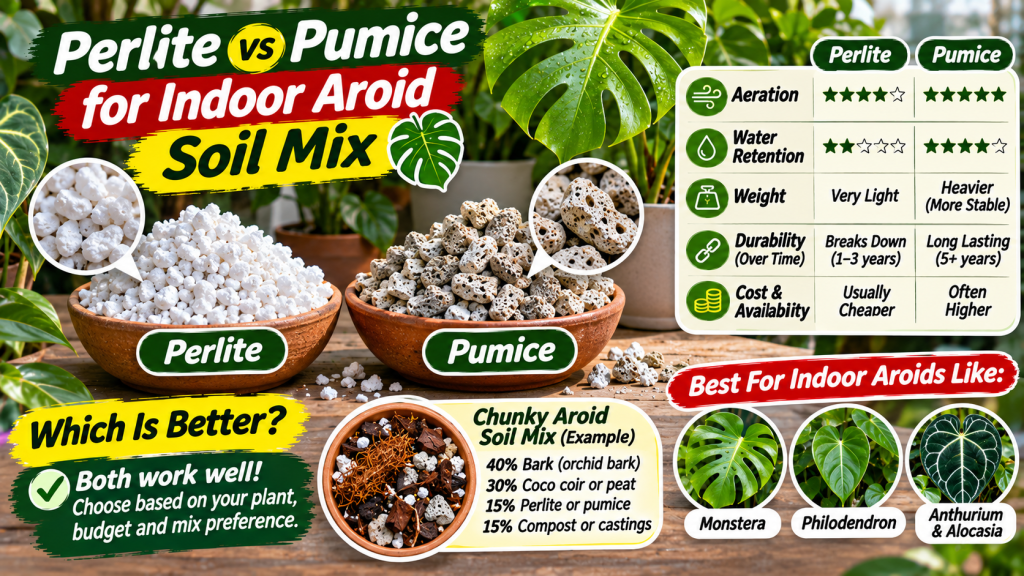
Perlite is heat-expanded volcanic material with a very low bulk weight. It is widely used to lighten potting mixes and increase air space and drainage. Its main drawback in loose houseplant mixes is that the light particles can migrate upward or float during watering.
Porous natural volcanic rock
Pumice is a porous volcanic rock used to add structure, drainage and aeration. It is generally denser than horticultural perlite, so it is less likely to float out of the mix. Its pores can hold some water while still allowing excess water to drain away.

Perlite vs pumice: the practical differences
| Factor | Perlite | Pumice |
|---|---|---|
| Aeration | Creates useful air space and improves drainage. | Also creates air space and improves drainage. |
| Weight | Very light; useful when keeping a potting mix light is important. | Heavier than perlite in typical horticultural grades; can add stability to a top-heavy pot. |
| Water behaviour | Primarily used to improve air space and drainage; fine grades and the whole mix affect moisture behaviour. | Porous particles can hold some water while allowing excess to drain. |
| Movement in the pot | Can float or work toward the surface during repeated watering. | Usually stays more evenly distributed because it is denser. |
| Best use case | Budget-conscious blends, lightweight pots, propagation and general indoor mixes. | Chunky mixes, larger plants, and growers who dislike floating white particles. |
| Cost and availability | Often easier to find and economical, depending on local suppliers. | Can cost more or be less readily available in some areas; compare local prices by volume. |
| Handling | Fine dust can irritate the respiratory system; dampen before mixing and avoid breathing dust. | Screen out excessive fines and rinse dusty material before use. |
The Singapore National Parks Board’s GardeningSG guide describes both materials as porous amendments that improve drainage and aeration. It specifically notes that perlite can float toward the surface, while pumice pores can hold some water as excess drains away. The National Center for Appropriate Technology also advises avoiding inhalation of perlite dust. See GardeningSG’s soil-amendment guide and NCAT’s potting-mix component notes.
Which is better for Monstera, Philodendron and other aroids?
There is no single winner for every aroid. Choose based on the plant’s root system, pot size, room conditions, how quickly your mix dries and how often you water.
Monstera deliciosa
Either works. Use pumice if a large Monstera is in a tall, top-heavy pot and you want the mineral fraction to stay mixed. Perlite is suitable when you want a lighter, less expensive blend.
Philodendron
Both are useful in a bark-based mix. Pumice is convenient for chunky mixes that are handled or watered often; coarse perlite is a good lightweight alternative.
Anthurium
Use a breathable mix but do not let it become too dry between waterings. Choose particle sizes and organic ingredients that maintain an even moisture supply around the roots.
Alocasia
Many Alocasia prefer more consistent moisture than a very coarse epiphytic mix provides. Use either amendment sparingly at first and retain enough fine, moisture-holding substrate.
A practical indoor aroid soil mix recipe
Use this as a starting point for common indoor aroids such as Monstera and many Philodendrons. Measure by volume, not weight.
Beginner-friendly chunky mix
This is a starting recipe, not a tested universal formula. For a plant that needs more air and faster drying, increase the bark and mineral fraction slightly. For an aroid that dries too quickly, increase the moisture-holding potting base and use smaller bark pieces.
Should you mix perlite and pumice together?
You can. There is no requirement to use only one. A blend can balance low weight with more stable mineral particles, but buying both is not necessary. If you already have coarse perlite, start with it and observe how the pot dries before purchasing pumice.
How to prepare and use perlite or pumice
- Choose horticultural grade. Use clean, coarse or medium particles rather than dusty powder or fine construction aggregate. Match the particle size to the pot and root size.
- Reduce dust before mixing. Lightly dampen perlite before handling, work in a ventilated area and avoid breathing airborne dust. Rinse dusty pumice and let excess water drain.
- Measure by volume. Use the recipe as a starting point. Mix thoroughly so mineral particles are distributed throughout the root zone rather than forming a layer at the bottom.
- Use a pot with drainage holes. The growing medium should drain freely. Do not try to fix a pot without drainage by adding a thick layer of perlite or pumice.
- Water and observe. Water thoroughly, let excess run out, and check the mix over the next several days. If it stays soggy, increase coarse structure or adjust watering; if it dries too quickly, add more moisture-holding material.
For container plants, University of Florida IFAS recommends a loose, porous medium that combines moisture-absorbing ingredients with materials that help water drain. It also stresses the importance of drainage holes. Read the UF/IFAS container-media guidance.
Common mistakes to avoid
- Adding too much mineral amendment. A mix can become so open that it dries too quickly for the plant and your watering routine.
- Using dusty or very fine particles. Fines can fill the spaces that coarse particles are meant to create. Sieve out excessive dust.
- Choosing by appearance alone. White perlite does not automatically mean a better mix, and dark or grey pumice is not automatically too heavy. Check horticultural grade and particle size.
- Putting gravel or amendment only at the bottom. Mix the amendment throughout the substrate and use drainage holes; a bottom layer does not replace a suitable mix.
- Ignoring the plant’s drying pattern. Humidity, temperature, pot material, pot size, light and root density all affect how quickly an aroid pot dries.
The easiest way to choose
Pick perlite if light weight and low cost matter most. Pick pumice if you want particles that are less likely to float and a little more weight in the pot. Then adjust the bark and moisture-holding base to suit the individual aroid.
Frequently asked questions
Can I replace perlite with pumice in an aroid mix?
Usually, yes. For many indoor aroids, coarse horticultural pumice can replace perlite at a similar starting volume. Because products differ in size and porosity, check how quickly the finished mix dries and adjust if needed.
Is pumice better than perlite for Monstera?
Not universally. Pumice stays distributed more reliably and adds some weight, which can help with a large Monstera. Perlite is lighter and often more affordable. Both can improve the aeration of a bark-based mix.
Does pumice hold more water than perlite?
Pumice has pores that can retain some water, but actual water retention depends on its source, particle size and the whole mix. Do not assume that pumice alone will keep a pot moist; bark, coir and the potting base matter too.
Why does perlite float to the top of my plant pot?
Perlite is extremely lightweight. Repeated watering can move some particles toward the surface. Mix it through the substrate, water gently and consider pumice if particle movement bothers you.
What size perlite or pumice is best for indoor aroids?
Choose a clean medium or coarse horticultural grade that is proportionate to the pot and roots. Avoid a mix dominated by dust or tiny fines. Small pots generally need smaller particles than large planters, but the finished mix should remain open and drain well.
Can I use perlite or pumice by itself?
They can be used in specialist propagation or semi-hydroponic applications, but they are not complete, nutrient-rich potting mixes. For ordinary indoor aroids, combine them with a suitable moisture-holding base and structural organic ingredients.
Do perlite and pumice prevent root rot?
They can help create better aeration and drainage, but they cannot guarantee that root rot will not occur. Overwatering, poor drainage, unsuitable pot size, low light and damaged roots can still cause problems.
Sources and further reading
- Clemson Cooperative Extension – Indoor Plants: Soil Mixes. Container mix requirements and example foliage-plant recipes, including Monstera and Philodendron.
- Singapore National Parks Board – Soil Amendments. Practical notes on perlite and pumice, aeration, drainage, moisture and perlite movement.
- National Center for Appropriate Technology – Potting Mixes for Certified Organic Production. Perlite properties and handling precautions.
- University of Florida IFAS – Container Media. Combining moisture-retaining and draining ingredients and using containers with drainage holes.
This guide provides general indoor-plant information. Plant response depends on species, cultivar, environment, container and watering habits. Test a small batch before repotting an entire collection.