Balcony Solar Microinverter Ground Fault: What It Means and How the 800W Limit Applies
A microinverter ground-fault warning should never be ignored. Learn the difference between a PV-side ground fault and an AC residual-current trip, what to check without touching live equipment, and how Germany’s 800 VA plug-in solar limit fits into the safety rules.
1. What does a ground fault mean in a balcony solar microinverter?
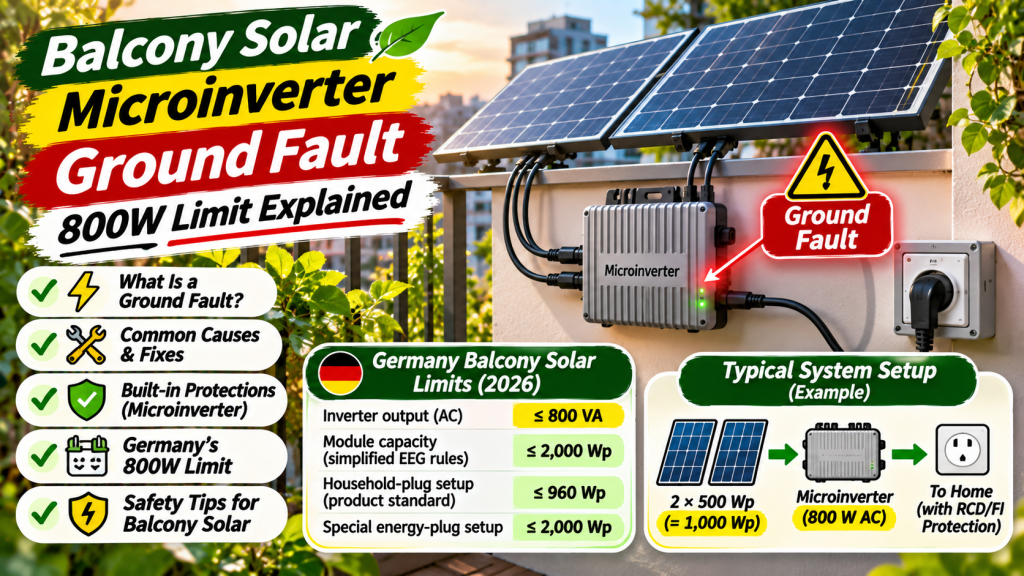
A ground fault is an unintended electrical connection between a live part of a circuit and earth, a grounded metal part, or a protective conductor. In a photovoltaic system, the problem may be on the direct-current (DC) side: for example, damaged insulation on a PV cable, moisture in a connector, a defective module junction box, or a conductor touching a metal frame.
Because solar modules produce DC voltage whenever they receive light, a PV-side fault can remain hazardous even after the inverter has stopped exporting power to the household circuit. A microinverter may detect an insulation or leakage-current problem and stop operating, but the exact detection method and error wording depend on the manufacturer and model.
Therefore, treat a “ground fault,” “earth fault,” “insulation fault,” or “GFDI” alert as a safety warning—not simply as a nuisance software error. Record the exact fault code and model number, then follow the manufacturer’s shutdown instructions.
The drawing separates possible DC-side and AC-side trouble areas. It does not identify which protection devices are required for a particular installation.
2. Ground fault vs. RCD trip: they are not the same thing
These terms are often mixed together in online discussions. However, they describe different parts of electrical protection.
PV-side ground / insulation fault
A DC conductor or component may be leaking current to an earthed or conductive part. The inverter may report an insulation, earth or ground-fault alarm and stop generating.
Typical area: PV modules and DC wiring
AC-side residual-current trip
An RCD (also called an FI or residual-current device) compares current flowing out and returning. An imbalance can cause it to disconnect the circuit. Leakage, damaged equipment or an unsuitable device can be involved.
Typical area: AC circuit and protection
Protective earthing is a third concept. It provides a designed protective path for fault current from exposed conductive parts where required. An RCD does not replace protective earthing, and an inverter’s internal monitoring is not a substitute for checking the building installation.
Likewise, an RCD trip does not automatically prove that the microinverter is defective. The cause may be the AC cable, socket, existing circuit, moisture, another appliance, or a device compatibility issue. Do not keep resetting a protective device to force the solar system to run.
3. Germany’s 800W balcony solar limit: what does it actually mean?
This article uses Germany as its regulatory example. The simplified German rules for plug-in solar devices distinguish the inverter’s AC output from the solar modules’ DC peak capacity.
| Measure | German simplified limit | What it describes |
|---|---|---|
| Inverter output | 800 VA AC | Maximum combined inverter apparent power under the simplified EEG rules. |
| PV module capacity | Up to 2,000 Wp DC | Combined installed module peak rating under the statutory simplified category. |
| Household plug under DIN VDE V 0126-95 | Up to 960 Wp | The product-standard figure for a household-plug configuration. |
| Special energy plug under DIN VDE V 0126-95 | Up to 2,000 Wp | Requires the specified special connection and professional installation/check of the outlet and circuit. |
Also, watts (W) and volt-amperes (VA) are not always interchangeable. The legal inverter figure is expressed as 800 VA; check the inverter nameplate and its conformity documentation rather than relying on a retailer’s headline “800W” description.
Under the simplified route, the total capacity of all plug-in solar devices behind the same relevant meter/connection point is considered. The Bundesnetzagentur also says the device must be entered in the Market Master Data Register (MaStR); the simplified route does not mean “no registration.” See the Federal Network Agency’s balcony-solar guidance.
4. What protection should a balcony microinverter provide?
A compliant plug-in solar device is assessed as a complete product system—not just as an inverter in isolation. DIN VDE V 0126-95, published in December 2025, covers product-level safety and testing for plug-in solar systems, including electric-shock protection, mechanical safety and risks to household wiring.
Depending on the design, a microinverter may include functions such as grid monitoring and disconnection, insulation or residual-current monitoring, and protection against certain PV-side faults. Some products use double insulation or Class II construction. Others use a particular grounding or bonding design. The details are model-specific.
- Read the exact product documentation. Look for the declared conformity to DIN VDE V 0126-95 and the model’s stated protection functions.
- Use the specified connectors and cables. The DKE warns against mixing DC connectors from different manufacturers or product families, even if they appear to fit.
- Do not assume a built-in function protects the building circuit. Product-level inverter protection and the electrical installation’s circuit protection serve different purposes.
- Do not add or change an RCD by guesswork. The correct protective arrangement depends on inverter characteristics, existing wiring and applicable installation rules.
The DKE’s FAQ says the product standard requires the inverter to disconnect within 100 milliseconds in the specified unplugging test and for touchable voltage at the device plug contacts to fall to no more than 34 V within one second. These are product-standard test requirements; they do not mean a user should test the plug or touch contacts while operating.
5. Common ground-fault warning signs and possible causes
| What you notice | Possible explanation | Safe response |
|---|---|---|
| “Ground fault” or “insulation fault” in the app | Possible DC insulation issue, moisture, damaged module or cable, or a connector problem. | Stop operation according to the manual and contact the manufacturer/installer. |
| RCD/FI trips when the system starts | Leakage current, damaged AC lead, moisture, inverter issue, circuit problem or compatibility issue. | Do not repeatedly reset it. Arrange an electrician’s inspection. |
| System stops after rain | Water ingress or dampness at a module, connector, cable or enclosure may be involved. | Do not open or dry electrical parts yourself. Keep the system off until inspected if the warning persists. |
| Visible cracked cable or connector | Mechanical damage, UV ageing, incorrect connector mating or strain. | Do not touch exposed conductors or unplug DC connectors. Keep people away and call a qualified technician. |
| Hot plug, burning smell, crackling or sparks | Possible loose contact, overheating, arcing or another serious electrical fault. | Keep clear. Isolate only if it can be done safely; call an electrician or emergency services if there is smoke/fire. |
6. What to do when the microinverter reports a ground fault
The safest approach is to preserve the fault information and avoid hands-on electrical troubleshooting.
- Stop and note the alert. Write down the exact error wording, LED pattern, time, weather conditions and inverter model. Save a screenshot from the monitoring app.
- Follow the manufacturer’s shutdown sequence. Use only the switch or AC isolation method described for your exact model, and only where the control is safe and accessible. If there is visible damage, water around live equipment, heat or arcing, keep away.
- Do not disconnect PV DC plugs under load. Solar modules can remain live in daylight. Do not pull MC4 connectors apart, open junction boxes, remove covers or touch exposed wiring.
- Make only a visual observation from a safe distance. Note obvious cable abrasion, crushed wiring, loose mounting, water pooling or a damaged enclosure. Do not handle or probe any part of the system.
- Contact the installer or manufacturer. Supply the fault code, model/serial number, photos taken from a safe distance, and whether the household RCD also tripped.
- Have the installation tested before restarting. A qualified electrician or authorised PV technician should identify and clear the cause, then confirm that the protective measures work.
7. What should a qualified electrician verify?
The scope depends on the fault and the system design. Rather than asking for a generic “grounding check,” provide the exact alarm and ask the professional to assess the relevant protection and the suitability of the circuit.
- Whether the household circuit, socket and overcurrent protection are suitable for the intended feed-in arrangement.
- Whether protective conductors, bonding and exposed metal parts are handled as specified by the equipment manufacturer and applicable standards.
- Whether the RCD type and characteristics are appropriate for the specific inverter and installation—without assuming one RCD type fits every model.
- Whether there is cable or connector damage, water ingress, insulation breakdown or a defective PV module/inverter.
- Whether the system’s plug, outlet, AC cable, DC connectors and mounting hardware are the correct matched components.
- Whether the installation complies with DIN VDE V 0126-95 for the plug-in product and the relevant installation rules, including DIN VDE V 0100-551-1 where applicable.
The DKE specifically notes that product conformity does not remove the need to consider the suitability of the existing building installation. Its guidance also warns that the solar feed-in current is not necessarily detected by the household circuit’s overcurrent protective device in the same way as current drawn from the grid. This is one reason circuit assessment matters.
8. Mistakes to avoid with an 800W balcony solar system
- Assuming the 800 VA limit is an earth-fault safety rating. It is an inverter power limit, not a ground-fault protection threshold.
- Assuming a 2,000 Wp panel array can always use a household plug. Product-standard connection limits and the outlet type matter.
- Using a multiway extension strip. The DKE FAQ says multi-socket strips are not permitted for connecting plug-in solar devices because of overload and disconnection risks.
- Mixing look-alike DC connectors. Use only compatible connector families specified by the manufacturer.
- Adding an RCD or changing its type without assessment. The right solution depends on the inverter and electrical system.
- Opening the microinverter to clear an alarm. This exposes hazardous components and can void the product’s safety approval or warranty.
9. Frequently asked questions
Does an 800W microinverter need ground-fault protection?
The required product-level protection depends on the applicable standards and the inverter design. In Germany, the plug-in solar system should be documented as conforming to the current product requirements, including DIN VDE V 0126-95 where applicable. Check the exact manufacturer’s declaration and instructions; do not infer protection features from the “800W” rating.
Is 800W the legal limit for balcony solar in Germany?
The simplified EEG limit is expressed as up to 800 VA of combined inverter output and up to 2,000 Wp of combined PV module capacity. However, DIN VDE V 0126-95 sets connection-specific module limits: up to 960 Wp for the household-plug configuration, or up to 2,000 Wp with the specified special energy connector and professional installation of the socket.
Does an RCD protect against every PV ground fault?
No. An RCD monitors residual current in the AC circuit; it does not necessarily detect every DC-side PV insulation fault. Inverter-integrated monitoring, protective earthing and the building’s AC protection perform different roles. The complete system must be assessed as designed.
Should I install a Type A or Type B RCD for a microinverter?
There is no safe universal answer for every balcony microinverter. RCD selection depends on the inverter’s residual-current characteristics, manufacturer instructions and the fixed installation. Have a qualified electrician check the product documentation and local requirements instead of replacing the RCD based on an online rule of thumb.
Why does my microinverter show a ground fault after rain?
Moisture may reveal damaged insulation or a compromised connector, cable or module enclosure. The timing alone does not identify the faulty part. Keep the system off if the warning persists and arrange an authorised inspection; do not open connectors or enclosures to dry them.
Can I keep using the solar system if the RCD trips only once?
Do not ignore a trip or repeatedly reset the RCD. Note the circumstances and follow the device manual. If it trips again, if the cause is unknown, or if there are any signs of damage, stop using the system and ask an electrician to investigate before restarting.
Can I troubleshoot a ground fault by unplugging the MC4 connectors?
No. Do not disconnect PV DC connectors under load or while modules are producing power. The connectors may arc and the PV wiring can remain energised in daylight. Use the manufacturer’s prescribed shutdown procedure and leave DC-side fault diagnosis to qualified personnel.
Does registering a balcony solar system prove it is electrically safe?
No. MaStR registration is an administrative requirement, not an electrical inspection or product-safety certificate. Registration and technical compliance are separate obligations.
Final checklist: safe balcony solar, not just an 800W label
A balcony microinverter ground-fault warning should be treated as a genuine safety event until the cause is understood. First, distinguish a PV-side insulation fault from an AC-side RCD trip. Next, check the exact model documentation and the Germany-specific power and connection rules. Finally, have a qualified professional verify the equipment and household circuit before normal operation resumes.
Remember: the 800 VA limit controls inverter output. It does not make damaged wiring safe, replace protective earthing, or guarantee that every socket is suitable. A compliant product, compatible connectors, a suitable electrical installation and correct fault response all matter.
Official sources and further reading
- DKE: FAQ to DIN VDE V 0126-95 — product requirements, power limits, electric-shock protection, installation overload and connector safety.
- VDE: Plug-in Solar Devices (Balcony Power Plants) FAQ — standards, grid connection and Germany’s 800 VA / 2,000 Wp simplified limits.
- Bundesnetzagentur: Balcony solar systems — statutory limits, aggregation and MaStR registration.
- DKE: Guide to mini-PV systems — why an electrician should assess the suitability of the household circuit and protective devices.
- Enphase: Resolving a ground-fault error in an IQ microinverter — an example of a manufacturer-specific DC-side fault and response guidance. Follow the instructions for your own brand and model.
Editorial and safety note: This is general educational information, not electrical design, installation, repair, legal or product-specific advice. It focuses on Germany’s plug-in solar framework as checked in November 2026. Standards, product approvals and local installation conditions can change; confirm the latest documents for your country, inverter and connection method. Electrical testing, protective-device selection and repairs should be carried out by qualified professionals.