Balcony Quail Cage Dimensions & Smell Control: A Practical Urban Setup Guide
A balcony quail setup needs more than a compact cage. You need enough usable floor space, safe shelter, dry litter, fresh air and a cleaning routine that stops manure odour before it reaches your home or neighbours. This guide explains how to plan a small Coturnix quail enclosure responsibly—and when a balcony simply is not suitable.
Cage dimensionsOdour controlUrban setupCan you keep quail on a balcony?
Sometimes, but only when the balcony is large, structurally suitable, well ventilated and protected from direct sun, heavy rain, strong wind and predators. Quail are ground-dwelling, social birds. They need a safe floor area for walking and foraging, hiding cover, dry substrate and access to a dust bath—not just enough room to stand beside a feeder.
Japanese or Coturnix quail can startle suddenly and spring upward. The enclosure must prevent escapes and reduce the chance of head injuries. It also needs secure mesh small enough to exclude rats and other predators, safe latches, and a roof or cover appropriate to the enclosure design. A bird that escapes from a balcony can fall or be injured.
There is no single balcony cage size that is right for every flock. Bird size, sex, group dynamics, floor design, enrichment and how long the birds spend in the enclosure all matter. The European Food Safety Authority (EFSA) review models a space allowance of 581 cm² per adult Japanese quail for a range of normal behaviours, but also notes that enclosure length matters for jumping and flight, estimating 2 metres as a minimum length for that purpose. Treat this as a scientific welfare reference—not a legal permission or a complete blueprint for a pet balcony enclosure.

Balcony quail cage dimensions: how much space do you need?
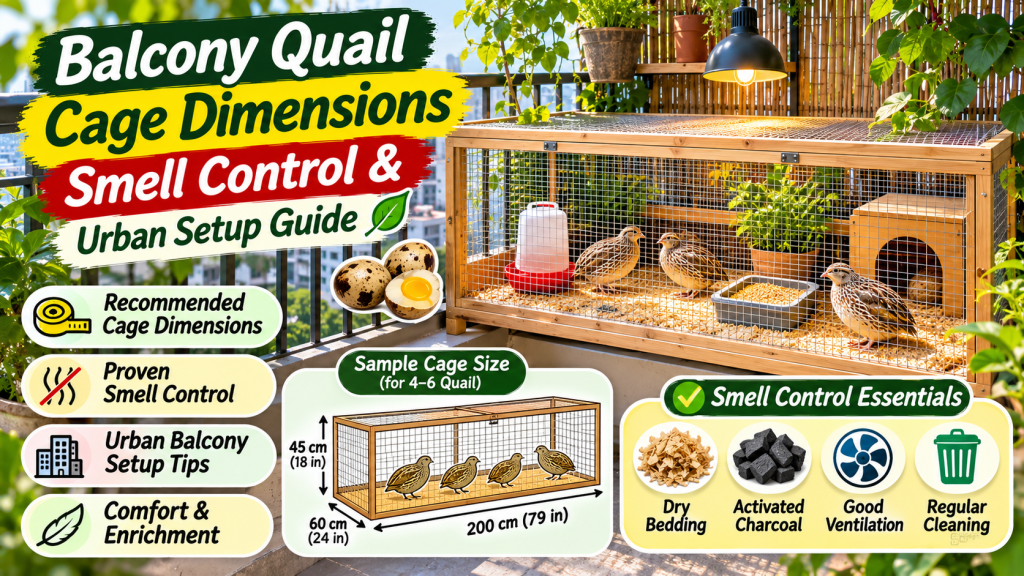
For a small urban flock, plan the enclosure around the birds first and the balcony second. Do not choose a bird count simply because a cage is available. The example below is a deliberately roomy planning layout for four adult female Coturnix quail; it is not a statutory minimum and should be adapted to the birds and local welfare rules.
| Planning item | Example for four adult hens | Why it matters |
|---|---|---|
| Enclosure footprint | About 200 × 60 cm (1.2 m²) | Provides a longer floor area for walking, foraging and separating functional zones. |
| Enclosure height | Design for safe movement; a taller aviary around 150 cm can allow more natural jumping and flight when safely constructed. | Quail flush upward when startled. A roof must be secure and designed to reduce impact injuries. |
| Dust-bath area | A stable tray around 35 × 35 cm or larger | Holds dry, fine dust-bathing substrate and can be removed for cleaning. |
| Covered / sheltered zone | At least one low hide large enough for birds to retreat together | Cover can reduce fear and give birds a place to get out of view. |
| Cleaning access | Full-width access door and removable tray or liner | Cleaning should not require dismantling the entire enclosure or reaching over a balcony edge. |
How many quail should you start with?
Do not keep a single quail alone. Quail are social and need compatible company. A small group of females is often quieter than a mixed group with a mature male, although hens still make sounds and are not silent. Females can lay eggs without a male; a male is only needed for fertile eggs. Male-to-female ratios and aggression require careful management, so beginners who only want eggs should research an all-female group from a reliable, accurately sexed source.
More birds mean more droppings, more feed, more cleaning and a greater chance of odour. For an urban balcony, start with the smallest socially appropriate group that your enclosure can genuinely support—never overcrowd to increase egg production.
A practical balcony quail layout
Think in zones so food, water, dust and droppings do not constantly contaminate one another.
- Dry resting and hiding zone: place a low shelter and visual cover at the quieter end of the enclosure. Use bird-safe materials with no sharp edges, loose loops or toxic finishes.
- Foraging floor: provide dry, friable litter over a suitable solid floor. Quail naturally scratch and peck, so do not rely on bare wire as their only floor surface.
- Dust-bath corner: use a removable tray of clean, dry, fine sand or another suitable dust-bathing substrate. Keep it away from the drinker so it does not become wet.
- Feeding and drinking zone: use stable, low-spill equipment. Position the drinker where splashes can be caught and removed without soaking the bedding.
- Manure collection zone: use a removable tray or accessible liner under the main resting area. It should not obstruct the birds or create a damp pocket.

Why does a balcony quail cage smell?
A strong poultry smell usually means that manure, wet bedding, spilled water or spoiled feed is building up. Fresh, dry litter should not produce a powerful ammonia-like odour. Odour is not just unpleasant for neighbours; it can signal poor air quality for the birds and the people cleaning the enclosure.
Common causes
- Wet droppings and bedding: leaking drinkers, rain entering the cage or damp litter accelerate decomposition and odour.
- Manure left too long: droppings collect beneath favourite resting areas, in corners and on trays.
- Spilled feed: damp feed can sour, attract flies and rodents, and create a persistent smell.
- Inadequate airflow: enclosed plastic sides or a covered balcony corner trap humidity and gases.
- Too many birds: a crowded flock creates more waste than a small enclosure can keep dry and clean.
- Dirty water equipment: algae, droppings and feed debris can contaminate drinkers.
Clemson Cooperative Extension’s poultry odour guidance highlights dry bedding, frequent manure removal, leak repairs, clean feeding equipment, removal of spoiled feed and adequate ventilation as core management practices. The same principles are useful for a small quail setup.
A simple smell-control routine for urban quail
Every day
- Remove visible droppings from trays and heavily soiled patches of litter.
- Check that bedding is dry; remove wet clumps immediately rather than covering them with fresh bedding.
- Rinse and refill drinkers, then wipe up spills.
- Remove damp or stale feed and keep stored feed in a sealed, rodent-resistant container.
- Check for flies, ants, rodents, unusual bird behaviour and any persistent ammonia smell.
Several times a week
- Empty and wash removable manure trays before waste builds up.
- Sift droppings and debris from the dust bath; replace substrate when damp or soiled.
- Turn or replace litter as appropriate for the material and moisture level.
- Wipe feeder and drinker surfaces with a bird-safe cleaning process, rinse well and dry before refilling.
Weekly or when needed
- Move birds to a secure temporary enclosure and clean the floor, corners, hides and tray channels.
- Replace contaminated bedding, allow surfaces to dry fully, and inspect the enclosure for leaks or sharp edges.
- Check mesh, latches, roof cover and balcony tie-downs after strong wind or heavy rain.
Best bedding, manure trays and waste handling
Choose a dry, absorbent, low-dust bedding that is safe for poultry and easy to replace. Depending on local availability, keepers commonly use clean wood shavings or other suitable poultry litter. Avoid aromatic cedar shavings, mouldy material, dusty sawdust, treated wood, cat litter with fragrances or clumping agents, and anything that becomes slippery when wet. Ask an avian veterinarian or experienced poultry supplier if you are unsure about a local bedding product.
A solid, non-slip floor covered with dry litter generally gives quail better opportunities to scratch, forage and dust-bathe than a bare wire floor. If a removable tray is used, make sure birds cannot stand on sharp edges or contact droppings beneath them. The tray should slide out safely without spilling waste over the balcony.
How to handle quail manure in an apartment
Wear disposable gloves when removing droppings, avoid raising dust, wash your hands with soap and water afterwards, and keep waste away from food-preparation areas. Put collected manure and soiled litter in a tightly closed, leak-resistant container for prompt disposal according to local waste rules. Do not rinse manure into balcony drains, gutters or neighbouring property. Composting poultry manure requires proper management and curing; do not apply fresh manure directly to edible plants.
Ventilation and weather protection on a balcony
Ventilation should remove humid, stale air without exposing birds to harsh drafts. Do not wrap the enclosure in plastic to contain odour: this traps moisture and makes the problem worse. Use a roof and partial wind/rain protection while leaving generous screened airflow on more than one side. Position the enclosure so rain cannot soak the bedding and direct afternoon sun cannot overheat the birds.
Balconies can become very hot, especially behind glass or on upper floors. Provide continuous shade, fresh water and a way for birds to move away from sun. Watch for panting, wings held away from the body, weakness or unusual inactivity; these can be signs of heat stress and need prompt action. Do not rely on a small fan blowing directly at the birds as the only climate-control measure.
Use strong, corrosion-resistant mesh and secure latches to keep out rats, cats and other predators. Protect the base and gaps around the frame. The enclosure must be stable in wind and must not be hung precariously from a railing. Check the balcony’s load capacity before placing a heavy enclosure, water containers or large bedding trays on it.
Noise, neighbours and local rules
Before buying birds, check your lease, apartment or condominium rules, building management policy and local council or animal-keeping requirements. Rules differ between cities and buildings; some restrict poultry, livestock, cages on balconies, nuisance odours or waste disposal. Do not assume that quail are automatically permitted because they are smaller than chickens.
Male Coturnix quail can crow, especially around dawn and during breeding activity. Hens also make calls, so an all-female group may reduce noise but cannot make a flock silent. Consider the proximity of neighbouring windows, bedrooms and shared balconies. If the birds, waste or cleaning water can affect neighbours, the setup is not suitable.
Balcony quail setup checklist
- ☐ Local rules and building permission checked.
- ☐ Enclosure size based on the birds’ welfare needs, not the smallest available cage.
- ☐ Compatible social group; no bird kept alone.
- ☐ Secure, predator-resistant mesh, latches and roof.
- ☐ Dry, non-slip floor with suitable bedding and a removable manure tray.
- ☐ Dust bath, hiding cover and room to forage.
- ☐ Stable, low-spill feeder and drinker.
- ☐ Ventilation, shade, rain protection and heat-stress plan.
- ☐ Daily spot-cleaning and regular tray/bedding replacement routine.
- ☐ Safe waste container and approved disposal route.
- ☐ A backup indoor or alternative safe location for severe weather or repairs.
Frequently asked questions
What size cage do I need for four Coturnix quail on a balcony?
There is no universal balcony cage size. A roomy planning example for four adult hens is about 200 × 60 cm of floor area, with secure weather protection, cover, dry litter and a dust-bath tray. This is an illustrative layout, not a legal minimum. EFSA’s welfare review discusses 581 cm² per bird for certain behaviours and estimates a 2 m minimum enclosure length for jumping and flight; provide more space where possible.
How do I stop a quail cage from smelling?
Keep bedding dry, remove droppings and wet clumps frequently, prevent drinker leaks, remove stale feed, wash trays and waterers, and maintain good airflow. A strong ammonia smell means the setup needs immediate cleaning and better moisture and ventilation control.
Are quail quiet enough for an apartment balcony?
Not always. Male Coturnix can crow, and females also vocalise. An all-female group may be quieter than a mixed flock, but you should check building rules and consider nearby neighbours before keeping any birds.
Can I keep one quail by itself?
No. Quail are social birds and should be kept with compatible companions. Do not solve space constraints by isolating a bird; instead, provide a suitable group enclosure or reconsider keeping quail.
What bedding is best for balcony quail?
Use dry, absorbent, low-dust poultry-safe bedding that can be replaced easily. Avoid mouldy or treated material, aromatic cedar, dusty sawdust, scented cat litter and bedding that stays wet. Ask a poultry-experienced veterinarian about materials available locally.
Can quail manure be composted?
It can be composted only with suitable management and adequate curing. Handle fresh manure carefully, keep it away from food areas, and do not apply it directly to edible plants. Follow local waste and composting guidance.
Do I need a male quail for eggs?
No. Female quail can lay eggs without a male. A male is needed only if you want fertile eggs for hatching. Male presence can also increase crowing and require careful group and ratio management.
Is keeping quail on a balcony legal?
It depends on your location, building rules, lease and local animal or nuisance regulations. Check with the relevant local authority and building management before purchasing birds; there is no single rule that applies everywhere.
Final thoughts: prioritise welfare before convenience
A low-odour balcony quail setup is possible only when the enclosure is spacious enough, dry, secure, shaded and easy to clean. The most effective smell control is simple husbandry: remove waste, prevent wet litter, keep feed and water clean, and provide good airflow.
If your balcony cannot provide enough room, safe shelter and a routine that protects both the birds and neighbours, choose a different urban gardening or pet project instead.
Sources and further reading
- EFSA Journal: Welfare of ducks, geese and quail on farm (2023) — space allowance, dust bathing, litter, cover and welfare recommendations.
- European Food Safety Authority: Welfare of quail on farm — plain-language overview of quail housing and welfare.
- Clemson Cooperative Extension: Odor Control from Poultry Facilities — bedding, manure, moisture, leaks, feed and ventilation management.
- Unusual Pet Vets: Caring for Your Quail — veterinary husbandry guidance on flooring, shelter, dust baths and escape prevention.
- Myshire Farm: Intro to Quail Aviaries — practical aviary features, bedding, dust baths and hiding areas.
This article is general husbandry information, not veterinary or legal advice. Space figures and example dimensions should not be treated as a substitute for local animal-welfare standards or advice from an avian veterinarian.