
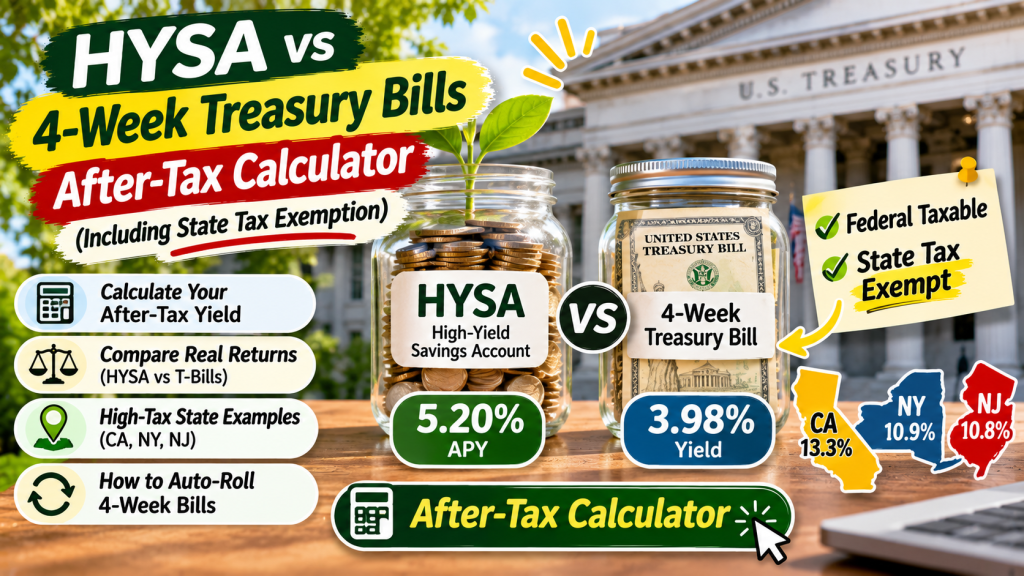
HYSA vs 4-Week Treasury Bills: State-Tax-Exempt Calculation
A high-yield savings account can advertise a higher rate, while a 4-week Treasury bill can offer a valuable state and local tax exemption. Compare both with your federal and state marginal tax rates, estimate the after-tax result, and find the HYSA rate needed to break even.
1. The state-tax exemption: what it really means
U.S. Treasury bills are short-term federal government securities. A 4-week bill has a 28-day term and is normally sold at a discount: you pay less than its face value and receive the face value at maturity. The difference is the bill’s interest.
For individual investors, interest from Treasury bills is generally included in federal taxable income but excluded from state and local income taxes. Bank-deposit interest, including interest earned in a high-yield savings account (HYSA), is generally taxable interest income. The IRS lists bank-account interest as taxable and separately confirms the state/local exemption for Treasury securities. See IRS Topic 403 and Publication 550.
| Tax treatment | HYSA interest | 4-week Treasury bill interest |
|---|---|---|
| Federal income tax | Generally taxable | Generally taxable |
| State income tax | Generally taxable, subject to state rules | Exempt |
| Local income tax | May apply, depending on location | Exempt |
| How the return is paid | Interest is credited under the bank’s account terms, often monthly | Discount is realized when the bill matures |
| Rate certainty | APY is usually variable and can change | Yield is fixed for the specific bill held to maturity |
The exemption is not a federal tax exemption. Treasury interest is still reported for federal income-tax purposes. For bills, the taxable interest is generally the difference between the purchase price and the amount received at maturity; consult the IRS instructions for your exact circumstances.
2. The after-tax yield formula
For a quick comparison, enter the annual HYSA APY, the 4-week bill’s investment yield or coupon-equivalent yield, your federal marginal income-tax rate, and your combined state/local marginal income-tax rate.
Using a simplified marginal-rate estimate:
The T-bill formula removes state and local tax because qualifying U.S. Treasury interest is exempt from those taxes. The federal rate still applies to both investments.
Find the HYSA break-even rate
To estimate the HYSA APY that would leave you with the same simplified after-tax annual yield as the T-bill:
If your HYSA APY is above that break-even figure, the HYSA has the higher estimated after-tax yield under these assumptions. If it is below, the T-bill may come out ahead.
This is a planning approximation, not a tax-return calculation. It assumes the marginal rates entered apply to the interest and does not automatically model deductions, credits, the net investment income tax, alternative minimum tax, state-specific adjustments, or changes in your tax bracket.
3. Worked example: 5.20% HYSA vs 3.98% T-bill
To show why the tax exemption matters—but does not always make the T-bill the winner—consider a hypothetical $10,000 investment. Assume a 5.20% HYSA APY, a 3.98% 4-week T-bill investment yield, a 24% federal marginal rate, and an 8% state/local marginal rate.
The 3.98% Treasury reference is the 4-week coupon-equivalent rate shown in the U.S. Treasury’s daily bill-rate table for October 30, 2026. It is a daily secondary-market quotation on the most recently auctioned bill, not a promise of the rate at your next auction. Treasury explains that coupon-equivalent yield is the comparable annualized yield based on purchase price. Check the official Treasury daily bill rates before investing.
| Illustrative input/result | HYSA | 4-week T-bill |
|---|---|---|
| Gross annualized rate | 5.20% APY | 3.98% coupon-equivalent yield |
| Federal marginal rate | 24% | 24% |
| State/local marginal rate | 8% | 0% on qualifying Treasury interest |
| Simplified after-tax annualized yield | 3.536% | 3.025% |
| Estimated after-tax earnings on $10,000 over 28 days | $26.50 | $23.20 |
In this example, the HYSA is ahead by about 0.51 percentage points in the simplified annualized comparison, or roughly $3.29 over one 28-day period on $10,000. The Treasury’s state-tax exemption narrows the gap; it does not erase a sufficiently large difference in gross yield.
Illustrative state-tax scenarios
The next table holds the other assumptions constant and varies only the state/local marginal rate. These are scenario rates—not a claim that every taxpayer in California, New York or New Jersey falls into that bracket.
| State/local marginal-rate assumption | HYSA after-tax yield | T-bill after-tax yield | HYSA break-even APY | Higher estimate |
|---|---|---|---|---|
| 6% | 3.640% | 3.025% | 4.321% | HYSA at 5.20% |
| 8% | 3.536% | 3.025% | 4.448% | HYSA at 5.20% |
| 10% | 3.432% | 3.025% | 4.586% | HYSA at 5.20% |
Under these assumptions, a 5.20% HYSA remains ahead at 6%, 8% and 10% state/local rates. At a lower HYSA APY, or a higher T-bill yield, the answer can change. That is why a calculator is more useful than a blanket claim that Treasury bills always win in high-tax states.
4. Interactive HYSA vs 4-week Treasury bill calculator
Change the principal, quoted rates and tax brackets to estimate your own comparison. Use the T-bill’s coupon-equivalent or investment yield—not its bank-discount rate—because the coupon-equivalent yield is the better annualized comparison with a bank APY.
Compare your after-tax return
Defaults are illustrative: $10,000, 5.20% HYSA APY, 3.98% 4-week T-bill yield, 24% federal marginal rate and 8% state/local marginal rate.
Calculation notes: HYSA term interest uses APY compounding; the bill estimate applies the entered annualized investment yield over the selected days. Taxes are approximated using marginal rates. Actual auction price, day count, settlement, bank compounding, itemized deductions and tax-return treatment can change the result. This tool is educational and does not calculate your tax liability.
5. How to apply it in California, New York and New Jersey
There is no single correct state tax percentage for everyone in a state. State income taxes are progressive, filing status matters, and some residents also pay local income taxes. Use the marginal rate that applies to the next dollar of interest—not the state’s top advertised rate unless that is actually your bracket.
California
California has a progressive personal income tax. Your state marginal rate depends on taxable income and filing status. The California Franchise Tax Board publishes annual rate schedules; its 2026 indexing notice lists the 2026 brackets and related changes. Add any relevant special taxes only if they apply to your situation. See the California FTB 2026 tax update and the current FTB tax-rate information.
New York
New York residents should distinguish New York State income tax from any New York City or Yonkers resident income tax that applies. For a New York City resident, the combined state and city marginal rate may be materially higher than the state rate alone. Use the correct tax-year schedule and include local tax where relevant. Start with the New York tax rates and tables and the state’s 2026 rate-change information.
New Jersey
New Jersey’s gross income tax is progressive. Use your actual marginal bracket rather than assuming that every New Jersey resident faces the top rate. The state-tax exemption for qualifying direct U.S. Treasury obligations is separate from New Jersey’s treatment of bank-deposit interest. See the New Jersey Division of Taxation for current forms and guidance.
6. How to auto-roll 4-week bills
A 4-week bill matures after 28 days. If you want to keep the money invested, you can reinvest the maturity proceeds into another bill. The process differs between TreasuryDirect and brokerage accounts.
TreasuryDirect
- Open a TreasuryDirect account and complete the account verification process.
- Choose a 4-week Treasury bill in the auction schedule and place a noncompetitive purchase order.
- When placing the original order, choose the reinvestment option if you want the proceeds used to buy another bill of the same term.
- You can also schedule a reinvestment up to four business days before maturity. TreasuryDirect explains how to manage or cancel reinvestments through ManageDirect.
- Keep enough cash available for any purchase-price adjustment and review each new auction’s rate; the next 4-week yield is not guaranteed to match the prior one.
Read the official TreasuryDirect reinvest-or-redeem instructions. TreasuryDirect’s bill page also explains the available terms, $100 minimum purchase, maturity payment and tax treatment: Treasury bills at TreasuryDirect.
Brokerages
Some brokerage platforms support recurring Treasury purchases or automatic reinvestment; the details, eligible terms, minimums and timing vary by firm. Before choosing a brokerage, check whether it supports 4-week auction purchases, auto-roll, fractional amounts, secondary-market sales and transfer fees. Do not assume every broker offers identical features.
A brokerage account may make it easier to hold Treasury bills alongside other investments and may provide a secondary market if you need to sell before maturity. However, a pre-maturity sale can produce a gain or loss depending on market prices and any transaction costs. Holding to maturity avoids that market-price sale, assuming the U.S. government pays as promised.
7. Liquidity, rate changes and risks
| Consideration | HYSA | 4-week T-bill |
|---|---|---|
| Access to cash | Typically easy access, subject to bank terms and transfer timing | Cash is tied up until maturity unless sold through a broker or transferred for sale |
| Rate changes | Variable APY can change at any time under account terms | Yield is set for the bill you buy and hold to maturity; future roll rates can change |
| Deposit insurance | Eligible deposits may be FDIC-insured within applicable limits and ownership categories | Not an FDIC deposit; it is a U.S. government security |
| State/local income tax | Generally applies where state/local income tax applies | Generally exempt for qualifying Treasury interest |
| Best fit | Emergency reserves and cash that may be needed any day | Cash you can leave invested until the maturity date |
For money you may need immediately, compare liquidity as well as the after-tax yield. A slightly higher calculated return may not compensate for the inconvenience or potential sale-price risk of locking cash into a bill. Also compare the HYSA’s current APY, minimum balance, fees, withdrawal rules and whether the bank is FDIC-insured.
8. When does a 4-week T-bill make more sense?
- Your state/local marginal rate is high: the state-tax exemption becomes more valuable as the tax rate on bank interest rises.
- The HYSA rate has fallen: if the bank APY falls below the calculated break-even APY, the T-bill may deliver the higher estimated after-tax return.
- You can wait until maturity: a 4-week bill is more suitable when you can set aside the cash for the full term.
- You want a known return for one term: the yield on a purchased bill is fixed through maturity, while a HYSA APY is usually variable.
A HYSA may make more sense when it pays substantially more, when you need same-day or frequent access to funds, or when you do not want to manage auction and maturity dates. There is no universal winner: run the numbers with current yields and your own marginal tax rates.
Frequently asked questions
Are 4-week Treasury bills exempt from state income tax?
Interest from direct U.S. Treasury bills is generally exempt from state and local income taxes but remains subject to federal income tax. Check the rules for the specific security and your tax circumstances. The IRS confirms this treatment in Publication 550.
Is HYSA interest taxable in California, New York and New Jersey?
HYSA interest is generally taxable interest income for federal purposes and is generally included in state taxable income, subject to each state’s rules. New York residents may also have city or Yonkers resident tax. Use your actual marginal state and local rate.
Can a 4-week Treasury bill beat a 5.2% HYSA?
It can in some circumstances, but it does not automatically do so. With a 3.98% T-bill yield, 24% federal marginal rate and 8% state/local marginal rate, the simplified example in this guide gives the HYSA the higher after-tax yield. Enter your own rates in the calculator.
Should I use the T-bill bank-discount rate or coupon-equivalent yield?
Use the coupon-equivalent (investment) yield for a comparison with a savings-account APY. The bank-discount rate uses face value and a 360-day convention, so it is not directly comparable to a bank APY. The U.S. Treasury explains the difference in its daily bill-rate table notes.
Can I automatically reinvest a 4-week bill?
Yes. TreasuryDirect lets you schedule reinvestment of maturing bills into another bill of the same term. You can set it when purchasing or, subject to its timing rules, up to four business days before maturity. See the TreasuryDirect reinvestment instructions.
Does the calculator include the state-tax deduction on my federal return?
By default, no. Some taxpayers who itemize may receive a federal tax benefit from deductible state and local income taxes, but eligibility and limits matter. The optional checkbox shows an alternate estimate only if you actually benefit from an additional deduction. Ask a qualified tax professional about your situation.
Are Treasury bills risk-free?
Treasury bills are backed by the U.S. government, but they still involve reinvestment risk, inflation risk and liquidity considerations. Selling before maturity can result in a gain or loss. A HYSA and a Treasury bill also have different legal protections and access characteristics.
Make the comparison with your own numbers
Enter the current HYSA APY, the current 4-week bill coupon-equivalent yield and your marginal tax rates in the calculator above. Recheck rates before each new bill purchase because auction yields and savings APYs can change.
Sources and further reading
- IRS Publication 550 — Investment Income and Expenses: Treasury interest federal taxation and state/local exemption.
- IRS Topic 403 — Interest Received: taxable bank-account interest and Treasury interest.
- TreasuryDirect — Treasury Bills: terms, minimum purchase, maturity and tax overview.
- U.S. Treasury — Daily Treasury Bill Rates, October 2026: 4-week bank-discount and coupon-equivalent quotes, including October 30, 2026.
- TreasuryDirect — Reinvest or Redeem Treasury Bills: how to schedule, edit or cancel reinvestment.
- IRS Revenue Procedure 2025-32 / 2026 tax-rate tables: federal income-tax brackets for tax year 2026.
- California Franchise Tax Board — October 2026 Tax News: 2026 California bracket indexing and rate schedules.
- New York Department of Taxation — Tax Rates and Tables: New York State and local tax tables.
Disclosure: This article is for general educational purposes and is not tax, legal or investment advice. The calculator uses simplified marginal-rate assumptions and may not reflect your actual tax liability. Rates are time-sensitive. Verify current Treasury auction yields, bank APYs, tax rules, fees and account terms before acting. If this page later includes affiliate links, add a clear affiliate disclosure before those links.