
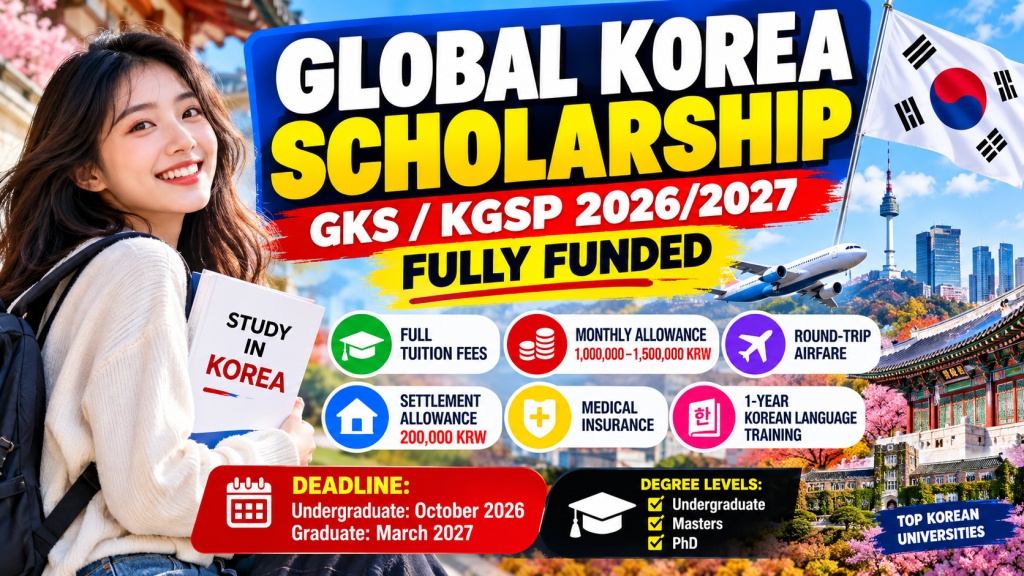
RAKIYALK | SCHOLARSHIP GUIDE | 2027 INTAKE
Global Korea Scholarship 2027: Eligibility, Benefits, Application Guide & Deadlines
Last updated: 30 October 2026
The Global Korea Scholarship (GKS) 2027, formerly known as the Korean Government Scholarship Program (KGSP), offers international students the opportunity to pursue higher education in South Korea with substantial financial support. Administered by the National Institute for International Education (NIIED) under South Korea’s Ministry of Education, the programme supports selected students at participating Korean universities.
This guide covers study options, eligibility, funding, application routes and required documents. It also explains the difference between the published 2027 undergraduate call and the graduate application cycle, which follows a separate schedule.
Important: This article is an independent information resource published by Rakiyalk. It is not an official scholarship announcement or a guarantee of eligibility or selection. Scholarship rules, benefits, quotas and deadlines can change. Always check the latest NIIED guideline, university information file and relevant Korean Embassy notice before applying.
1. Global Korea Scholarship 2027: Application Status and Deadlines
GKS does not use one deadline for every study level. NIIED announces undergraduate and graduate applications separately. Also, each university may set its own University Track deadline.
| Programme | Status as at 30 October 2026 | What applicants should do |
|---|---|---|
| 2027 Undergraduate – Embassy Track | Closed. The published application period was 15–30 September 2026, ending at 6:00 PM Korea Standard Time (KST). | Prepare for a future intake and monitor the official notice board. |
| 2027 Undergraduate – University Track | University-specific application periods run during September–November 2026. There is no single deadline for all participating universities. | Check the 2027 University Information file and contact each university directly to confirm whether its application window is still open. |
| 2027 Graduate – Master’s and Doctoral | NIIED had not posted a general 2027 GKS Graduate (GKS-G) guideline on its official notice board by 30 October 2026. | Do not rely on an unverified March 2027 deadline. Wait for the 2027 GKS-G guideline and check the Embassy and university notices. |
The 2027 undergraduate Embassy Track deadline has passed. However, some University Track deadlines may differ. Do not assume that every university still accepts applications just because the overall period runs into November.
For students in Sri Lanka, the 2027 undergraduate guideline lists Sri Lanka as an eligible country. However, applicants must still check the Korean Embassy in Sri Lanka’s notices for local instructions, selection details and extra documents.
2. What Is the Global Korea Scholarship (GKS)?
The Global Korea Scholarship is a scholarship funded by the Korean Government. It helps students from other countries study at universities in South Korea. In addition, the programme supports education links and long-term ties between Korea and other countries.
The National Institute for International Education (NIIED) runs GKS under Korea’s Ministry of Education. People once called the scholarship KGSP; today, its official name is GKS.
NIIED offers GKS through different programmes and application routes. Each year’s guide lists the study levels, eligible countries, universities, departments and number of places. However, not every university or course in South Korea takes part.
3. Available Study Programmes and Scholarship Duration
GKS offers associate, bachelor’s, master’s and doctoral study options. Most scholars first study Korean for one year. They then begin their degree programme, unless the current guide lists an exception.
| Study programme | Typical duration |
|---|---|
| Associate degree | 1 year of Korean language training + 2–3 years of degree study |
| Bachelor’s degree | 1 year of Korean language training + 4–6 years of degree study |
| Master’s degree | 1 year of Korean language training + 2 years of degree study |
| Doctoral degree | 1 year of Korean language training + 3 years of degree study |
These are standard programme structures. Specialised programmes, including certain research, R&D and Global Network options, may have different arrangements or exemptions. Applicants must check the relevant programme section in the current guideline.
You can choose only the universities and departments listed in that year’s official University Information file. Also, the standard degree scholarship usually does not cover online, distance-learning, short-term or evening courses.
4. Global Korea Scholarship 2027 Benefits and Financial Coverage
The 2027 undergraduate guide lists the funding figures below. Do not use these amounts for the 2027 graduate programme. NIIED publishes separate rules for graduate applicants, so check the GKS-G guide when it becomes available.
These figures apply only to the published 2027 undergraduate guide. For graduate funding, check the separate GKS-G guide when NIIED publishes it.
| Benefit | 2027 undergraduate guideline |
|---|---|
| Tuition fees | NIIED provides up to KRW 5 million per semester. The university covers tuition exceeding that amount and the admission fee, according to the guideline. |
| Korean language training fee | KRW 5.2 million per year, paid to the university for scholars in the language programme. |
| Airfare | Economy-class airfare based on actual expenses, subject to the programme’s conditions. |
| Allowance during Korean language training | KRW 13.56 million per year. |
| Allowance during the degree programme | KRW 14.4 million per year. |
What the annual allowance includes
The guide says the annual allowance already covers living costs, accommodation, health insurance, Korean language grants, TOPIK test fees, settlement support and degree-completion grants. Therefore, do not list these items as extra guaranteed payments on top of the allowance.
Airfare and costs you may need to pay
NIIED may change scholarship amounts. Airfare also comes with conditions. For example, NIIED does not provide entry airfare to newly selected scholars who already live in Korea when it announces the final results. The 2027 undergraduate guide also excludes travel within the applicant’s home country and travel insurance for the journey to Korea.
Important: “Fully funded” does not mean that the scholarship pays every personal expense. So, read the current guide and university information carefully. Also, set aside money for any costs that the scholarship does not cover.
5. Global Korea Scholarship Eligibility Requirements
Your eligibility depends on your study level, scholarship category, country and the annual guide. The sections below explain the published 2027 undergraduate rules first. They then summarise the general rules for graduate applicants.
5.1 Undergraduate eligibility for the 2027 GKS-U programme
- Nationality: Applicants must hold citizenship of a country that NIIED lists for the programme. Their parents or legal guardians must also hold citizenship outside Korea. In general, applicants cannot apply if they or their parents hold Korean citizenship, including dual citizenship. However, the 2027 guide gives the University Industry Cooperation (UIC) programme a special all-country rule.
- Age: Applicants must be younger than 25. For the 2027 programme, they must have a birth date of 1 March 2002 or later.
- Education: For a bachelor’s programme, applicants must have finished high school or an associate degree. They may also apply if they expect to finish by the deadline in the guide. For an associate degree, applicants must have finished high school or expect to finish by the stated date. However, people who already hold a bachelor’s degree cannot apply for the undergraduate programme.
- Academic results: Applicants must meet at least one of these standards: 80% or higher on a 100-point scale; a place in the top 20% of the class; or an equivalent cumulative GPA (CGPA) of 2.64/4.0, 2.80/4.3, 2.91/4.5 or 3.23/5.0.
- Health: Applicants must have good physical and mental health so they can complete the programme in Korea.
- Other rules: Applicants must be able to travel overseas. They must also follow the rules on previous GKS awards and duplicate applications.
If your school uses a different grading system, do not guess how your marks convert. Instead, provide the official supporting information that the guide asks for when your transcript does not show a matching GPA or class rank. Also, submit your final graduation certificate by the deadline if you apply as an expected graduate.
5.2 Graduate eligibility: Master’s and PhD applicants
For the general GKS Graduate programme, applicants must be citizens of an invited country. Neither the applicant nor their parents may hold Korean citizenship. Master’s applicants need a bachelor’s degree, while PhD applicants need a master’s degree. In both cases, applicants must finish the degree by the date in the annual guide.
NIIED’s general information sets the usual age limit for graduate applicants at under 40. The annual guide explains the date used to check each applicant’s age. However, some current university professors from eligible aid-recipient countries may qualify under a special under-45 rule. Check the 2027 GKS-G guide for the exact birth-date cut-off, country list and exceptions.
The 2026 GKS-G guide asked applicants to have at least 80%, a place in the top 20% of their class or an accepted equivalent CGPA. You can use this rule to prepare. However, check the 2027 graduate guide again because NIIED may change the requirements.
Language rules differ between programmes and universities. For example, a TOPIK or recognised English test result may strengthen your application. Some departments may also require a test result. Therefore, check the language rules for your chosen programme instead of assuming that every course follows the same rule.
6. Embassy Track vs University Track: What Is the Difference?
Most applicants use one of two routes: the Embassy Track or the University Track. However, the route and categories open to you depend on your study level and the annual guide.
Embassy Track
Applicants apply through the Korean Embassy or another approved organisation in their country. For the 2027 undergraduate general category, applicants sent their Embassy Track forms online through the Study in Korea system. They could choose up to three participating universities and had to include at least one Type B university. R-GKS applicants followed a separate Type B university rule.
The Embassy Track has several review stages. First, the recommending embassy checks the application. Next, NIIED reviews the shortlisted applications. Finally, the chosen university checks whether the applicant meets its admission rules.
University Track
Applicants apply directly to a participating Korean university. Each university sets its own submission method. For the 2027 undergraduate call, universities set their own application dates, generally between September and November 2026. So, check the university’s instructions carefully. Some universities use an online form, while others may ask for paper documents.
Under the 2027 undergraduate guide, University Track applicants could choose one university and one department. Therefore, do not use the Embassy Track rule that allows up to three university choices for this route.
Which route should you choose? Neither route guarantees a scholarship. Instead, compare the scholarship category, university, department, deadline and submission method. Also, choose a course that fits your study goals. Before you apply, check the annual guide for rules on duplicate applications.
7. Global Korea Scholarship Required Documents Checklist
The document list changes by study level, application route, category and country. The checklist below covers the main documents in the 2027 undergraduate guide. However, it is only a starting point. Always use the official form and document list for your application.
Application forms and statements
- GKS application form
- Personal statement
- Study plan
- Letter of recommendation (completed by the recommender)
- GKS applicant agreement
- Personal medical assessment
- Consent to collect and use personal information
Academic and identity documents
- Proof of citizenship for the applicant and parents, together with proof of family relationship
- High school graduation certificate or expected graduation certificate
- Official academic transcript
- Associate degree certificate and transcript, where applicable
- Passport copy, where requested
- Valid TOPIK or English-language test result, if available or required
- Copies of awards and evidence of relevant activities or achievements, where applicable
- Additional category-specific evidence, such as overseas Korean, adoptee or Korean War veteran descendant documents, if applicable
Document authentication and translation
First, separate the forms you must complete from the certificates you must provide. For the first stage of the 2027 undergraduate Embassy Track, applicants uploaded scanned copies online. However, applicants who passed the first round then had to send original and authenticated certificates by the embassy’s or university’s deadline.
Most required certificates need an apostille or consular confirmation. The correct option depends on the country and document. An apostille is an official stamp that confirms a document’s origin for use in another country. Also, documents written in a language other than Korean or English need a certified translation. Since rules differ, ask the Korean Embassy or university what each document needs before you pay for certification.
Therefore, do not assume that you must apostille every document before the first online application. Also, a notarised photocopy may not count as an authenticated original. Follow the instructions for each stage of the application.
8. How to Apply for the Global Korea Scholarship
- Read the current annual guideline. Download the correct undergraduate or graduate guideline from the official Study in Korea GKS notice board.
- Confirm your eligibility. Check your nationality, age, academic qualifications, GPA, health requirements and any category-specific conditions.
- Select your programme and track. Decide whether the Embassy Track or University Track is available and suitable for your application.
- Research universities and departments. Use the official University Information file to identify eligible institutions, programmes, language requirements and department-specific conditions.
- Prepare your application documents. Write your personal statement and study plan, request a recommendation letter and obtain the required academic and citizenship certificates.
- Arrange authentication and translation. Confirm whether each document needs an apostille, consular confirmation or certified translation, and follow the stage-specific submission instructions.
- Submit through the correct channel. Use the Study in Korea online system for the relevant Embassy Track. For University Track, follow the university’s own application process and deadline.
- Monitor selection announcements. Check your email, the embassy or university website and the official GKS notice board for interview, document and result updates.
Send your application to the relevant embassy or university, not directly to NIIED as an individual applicant. Finally, keep a copy of every form and certificate you submit.
9. Tips to Strengthen Your GKS Application
Write a focused personal statement
Explain your education, achievements, interests and reasons for choosing Korea. For example, describe a project, class or experience that shaped your goals. Avoid general statements that could fit any applicant.
Connect your study plan to the chosen department
Show why the university and course match your goals. Then explain what you plan to study and how the degree will support your career or research. Graduate applicants should also set out a clear and realistic research plan.
Prepare for Korean language study
For the standard 2027 undergraduate route, scholars should reach at least TOPIK Level 3 during the Korean language year before they start their degree. However, applicants who already have TOPIK Level 5 or 6 may qualify for an exemption. In addition, the 2027 undergraduate selection gives extra points to applicants with TOPIK Level 3 or higher.
Choose universities carefully
Check each university’s location, courses, language rules and admission steps. Above all, choose a university that supports your study plan. Do not choose one only because it has a famous name.
Request recommendations early
Choose someone who knows your academic work, effort or research skills. Then give that person enough time to write the letter. Share correct details about the course and your goals as well.
Check every certificate and deadline
Check that your name, dates, translations and academic records match across all documents. Start early. However, arrange document checks based on the annual guide; do not assume that you must apostille everything two months before you apply.
10. Frequently Asked Questions About GKS 2027
Funding and application dates
Is the Global Korea Scholarship fully funded?
GKS can cover tuition support, Korean language training, airfare and a living allowance. However, the exact benefits depend on the study level and annual guide. Some costs and travel situations have special rules, so read the funding section carefully.
Is the 2027 undergraduate GKS application still open?
The 2027 undergraduate Embassy Track closed on 30 September 2026 at 6:00 PM KST. However, each university sets its own University Track deadline, usually between September and November 2026. Contact the university to check whether it still accepts applications.
When will the 2027 GKS Graduate application open?
As of 30 October 2026, NIIED had not posted a general 2027 GKS Graduate guide on the official notice board checked for this article. The graduate programme has its own annual announcement. Therefore, do not rely on an estimated deadline or payment amount until NIIED publishes the guide.
Eligibility and Korean language requirements
Can students from Sri Lanka apply?
The 2027 undergraduate GKS guide lists Sri Lanka as an eligible country. However, applicants must still meet every requirement and follow the instructions from the Korean Embassy in Sri Lanka or their chosen university.
Do I need TOPIK before applying?
You do not need a TOPIK certificate for every GKS category. However, a good language result can strengthen your application. Some universities or departments may also ask for proof of language ability. Standard undergraduate scholars should reach TOPIK Level 3 during the language year before they move to the degree programme. Check the current guide for exceptions.
Tuition, documents and application rules
Is a 100% tuition fee waiver guaranteed at every university?
Under the 2027 undergraduate guide, NIIED pays up to KRW 5 million per semester. The university covers any tuition above that amount and the admission fee. Even so, confirm the funding rules for your chosen course and university.
Do I need apostilled documents when I first apply?
For the 2027 undergraduate Embassy Track, applicants first sent scanned copies online. Those who passed the first round then had to submit original and authenticated certificates by the stated deadline. However, the rules for stamps and translations depend on the document and country. Always follow the latest guide and local embassy instructions.
Can I apply through both the Embassy Track and University Track?
Do not send more than one application unless the annual guide clearly allows it. The 2027 undergraduate guide limits duplicate applications across tracks and programmes. So, read that section before you submit your forms.
11. Official Global Korea Scholarship Application Links
Use these official websites to check the latest scholarship information. In particular, read the annual guide before you prepare or submit documents:
- Study in Korea – Official application and information portal
- 2027 Global Korea Scholarship for Undergraduate Degrees – NIIED notice and guideline attachments
- 2027 GKS Undergraduate University Track – university-specific information
- Official GKS scholarship notices and updates
- NIIED – GKS Degree Programme overview and general eligibility
- Embassy of the Republic of Korea in Sri Lanka